

Introduction
AI tools, such as ChatGPT and Gemini, are rapidly changing how people find information, which in turn changes how businesses need to appear online. Traditional search is no longer just about finding information, users are expecting instant, accurate and concise answers delivered to them through AI summaries. Users are no longer browsing through multiple links to find what they want, they accept the first good answer which in turn is causing a rise in zero-click searches. In fact, around 60% of users don’t click through to a single result, completely changing how the fundamental calculation of how SEO works. This change is causing a seismic shift in digital marketing, moving the focus from visibility alone to delivering value at the exact moment a question is asked.
To keep up, marketers need to think beyond traditional SEO (Search Engine Optimisation). A new, more holistic approach is emerging which combines SEO with AEO (Answer Engine Optimisation) and GEO (Generative Engine Optimisation), blending them together into one unified strategy with the aim of being chosen as a trusted source by AI.
In this blog, we’ll explore how AI tools are reshaping the digital marketing world and how you can adapt your strategy to stay visible.
GEO and AEO: Rewriting the Rules of Search
Generative Engine Optimisation (GEO) focuses on being understood, cited and directly used within Large Language Models (LLMs) such as ChatGPT, Gemini and Perplexity. The idea is to use these sites to generate traffic to your website. As of March 2026, Chat GPT has approximately 900 million weekly active users reaching out for help. These users are who we need our content to be shown to.
Answer Engine Optimisation (AEO) is all about crafting content that quickly answers user questions, helping your information get picked up in AI summaries, featured snippets and voice search results. AEO focuses on preparing your content for AI discovery, increasing the likelihood that it appears as a direct answer to user queries. Google AI Overviews now appears in up to 50% of all Google search queries, which equates to a reach of 2 billion monthly users, and this is only going to increase over time.
In short, AEO ensures you have the right answer to a specific question whilst GEO ensures AI trusts your content enough to use it as a source. Working together with SEO, the aim is to try and ensure your content can be easily understood so it can feature in snippets as well as appearing on LLMs and while there is a lot of overlap between traditional SEO and emerging AEO/GEO, you can’ t just add some extra letters to your existing SEO strategy and expect to see AI success.
The Click is Disappearing
Zero-click google searches have increased significantly in the last few years. Recent data shows that around 60% of google searches now end without a click, partially following the rollout of features like Google’s AI Overviews which are providing people with immediate, summarised answers straight from the search results.
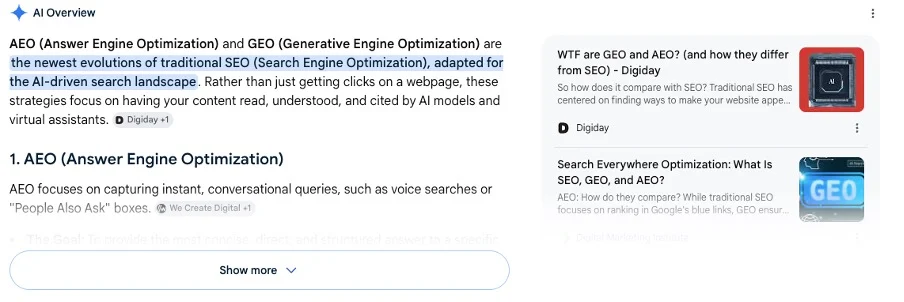
As a result, we can see that user behaviour is changing. Instead of browsing through multiple links, they use the AI summary to get an instant answer.
For marketers, this challenges our knowledge on visibility. Instead of visibility typically to a click, your content may now influence users and their perception of you without them ever needing to visit your website so click-through rates can’t be relied on as much for a measure of success.
Whilst they still matter, it now requires a careful balance: creating content that provides a concise, useful summary in the search results, yet also encouraging the users to click through to deeper, actionable insights. The goal is to get cited in the answer, whilst still capturing the all-important click.
4 Ways to Optimise Your Content for the New Era of Digital Marketing
- Make your content easy to understand
Clear, readable content keeps audiences engaged and helps AI models quickly digest the information and reuse your content as answers. There are many ways to improve readability, including: using bullet points or numbered lists for key details, adding visuals such as images and graphics, organising content with clear heading tags (H1, H2 and H3) to help navigation and using straightforward language without unnecessary jargon. Not only will these details help AI interpret the content, but it also makes it easier for users to consume.
- Add context and depth after the quick answer
Start with a clear, immediate response before expanding into the detail. This approach satisfies both featured snippets and LLMs. Featured snippets are typically around 40-50 words long, so keeping your initial answer concise increases your chances of being surfaced. However, if you only give a short answer, you decrease the likelihood of users clicking through to your website so it remains important to follow this with deeper, more valuable content.
- Use structured formats
Incorporate structured formats such as FAQs and How To guides to help AI systems even further. If you are directly answering commonly searched questions, it is more likely to be used in AI summaries and snippets. It is also helpful if your content is in multiple formats to incorporate the different communication methods; putting answers in text, video and image formats creates a more engaging experience for the user as well as helping AI digest the information better. To help guide AI models even further, you could wrap the content in a relevant schema markup within your website’s HTML. This will help guide AI models in understanding your pages and content accurately.
- Write strong headlines and meta descriptions
Compelling headlines and meta descriptions create curiosity for the user and highlights value that isn’t fully captured in the snippet alone. The aim is to give users enough information to trust you, whilst leaving a clear reason to click through to your website to find out more. Meta descriptions isn’t a direct Google ranking factor so may not help your search position, instead see it as a sales pitch to try and influence users to click-through to your website.
Conclusion
In summary, if you are not optimising for the answer engines you are risking becoming invisible. Success is no longer measured purely by rankings or clicks, but by where your content is recognised, trusted and used as the answer. As AI continues to shape how information is delivered, we need to continue to adapt to their rules if we want to remain visible.
Glossary
Generative Engine Optimization (GEO) is the approach to improving visibility on AI-driven search engines and appear in LLMs such as ChatGPT, Perplexity and Google Gemini.
Answer Engine Optimisation (AEO) is the practice of structuring content to be directly cited, quoted or recommended by AI-powered search tools such as Google AI Overviews.
Large Language Models (LLM) are AI systems that are trained to understand, generate and summarise content to perform a wide range of tasks such as analyse data, answer questions, create original content and write code.
Schema Markup is a standardised code added to a website’s HTML. It provides search engines with clues about the page’s content, transforming unstructured text into clear definitions.